
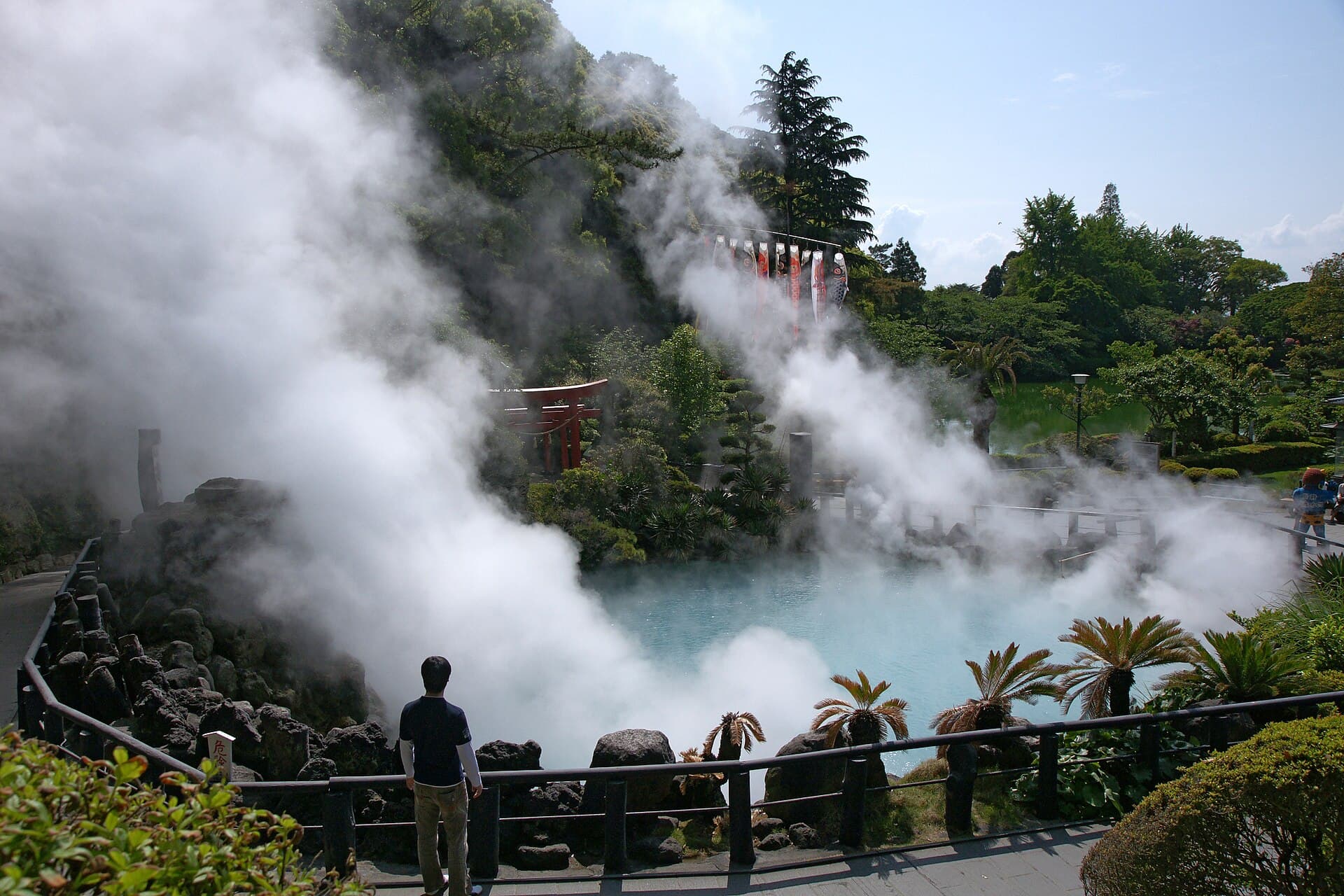
Beppu (別府) is a hot spring city where the numbers speak for themselves. Around 2,300 individual sources, and the highest hot spring output in Japan. It's not an exaggeration to say you'd hit hot water anywhere you dug in this town — steam rises even from quiet residential side streets. If Yufuin is all about quiet elegance, Beppu is the city that lets you experience onsen culture in its purest form.
Beppu is really a federation of eight hot spring districts known as the Beppu Hatto (別府八湯). The water and the atmosphere shift from one district to the next, which is why it's often called the ultimate onsen-hopping destination.
Things you can only do in Beppu
The Hells of Beppu (Jigoku Meguri)
A tour of seven scenic hot springs you look at rather than bathe in — think the boiling cobalt-blue "Sea Hell" and the crimson "Blood Pond Hell." This is Beppu's signature circuit, and half a day is plenty to see them all.
Sand baths (Suna-yu)
Put on a yukata and get buried up to your neck in hot volcanic sand on the beach. Beppu Beach Sand Bath in Kamegawa is considered the original. Ten to fifteen minutes in and you're drenched in sweat — a completely different kind of relief than a regular soak.
Steam baths and *toji* healing culture
From steam saunas heated by geothermal vents to the old tradition of long-stay hot spring cures, Beppu covers every genre of onsen experience there is.
Choosing a ryokan by district
Beppu Onsen (around the station and Kitahama) — easy access and sea views
The downtown district near the station and harbor. Plenty of hotel-style ryokan with ocean views, and easy access to restaurants and food stalls. If it's your first time in Beppu, this is the safe, convenient choice.
Kannawa (鉄輪) — a townscape wreathed in steam
Right next to the Hells, with steam rising from every alley — this is the most quintessentially "Beppu" district. Traditional ryokan sit alongside long-stay *toji* lodgings, and you shouldn't leave without trying *jigoku-mushi* (地獄蒸し), food steamed over geothermal vents.
Myoban (明礬) — cloudy sulfur baths
A sulfur district partway up the mountain, known for its milky, blue-white water and thatched-roof *yunohana* huts where mineral crystals are harvested. If you want the most intense hot spring experience, Myoban is the answer.
What's the water like?
The Beppu Hatto district spans seven of the ten recognized hot spring types in Japan, from simple thermal water to chloride, bicarbonate, sulfur, and acidic springs. The water changes as you move between districts, so even on a one-night trip, try to combine your ryokan's bath with at least one public bathhouse elsewhere in town. If you want a primer on spring types before you go, see our guide to onsen types and their effects.
Getting there and a suggested route
- 1Fukuoka (Hakata) to Beppu: About 2 hours on the Sonic limited express.
- 2Yufuin to Beppu: About 1 hour by bus or train. One night in Yufuin plus one night in Beppu is the classic golden route through Kyushu's onsen country.
- 3Getting around town is mostly by local bus — buses to Kannawa and Myoban run frequently.
How to choose
- First-time visitors, sea views → ocean-view ryokan around Kitahama
- Full onsen immersion → ryokan with natural spring baths in Kannawa or Myoban
- Best value for money → Beppu runs noticeably cheaper than Yufuin. See all Beppu ryokan
💡 At the same grade, Beppu ryokan often run ¥20,000–40,000 cheaper per night than their Yufuin equivalents. Putting those savings toward a better kaiseki dinner is a smart trade.
Where can you experience this?
Book directly at Japan's best onsen towns with Ryokanear.