
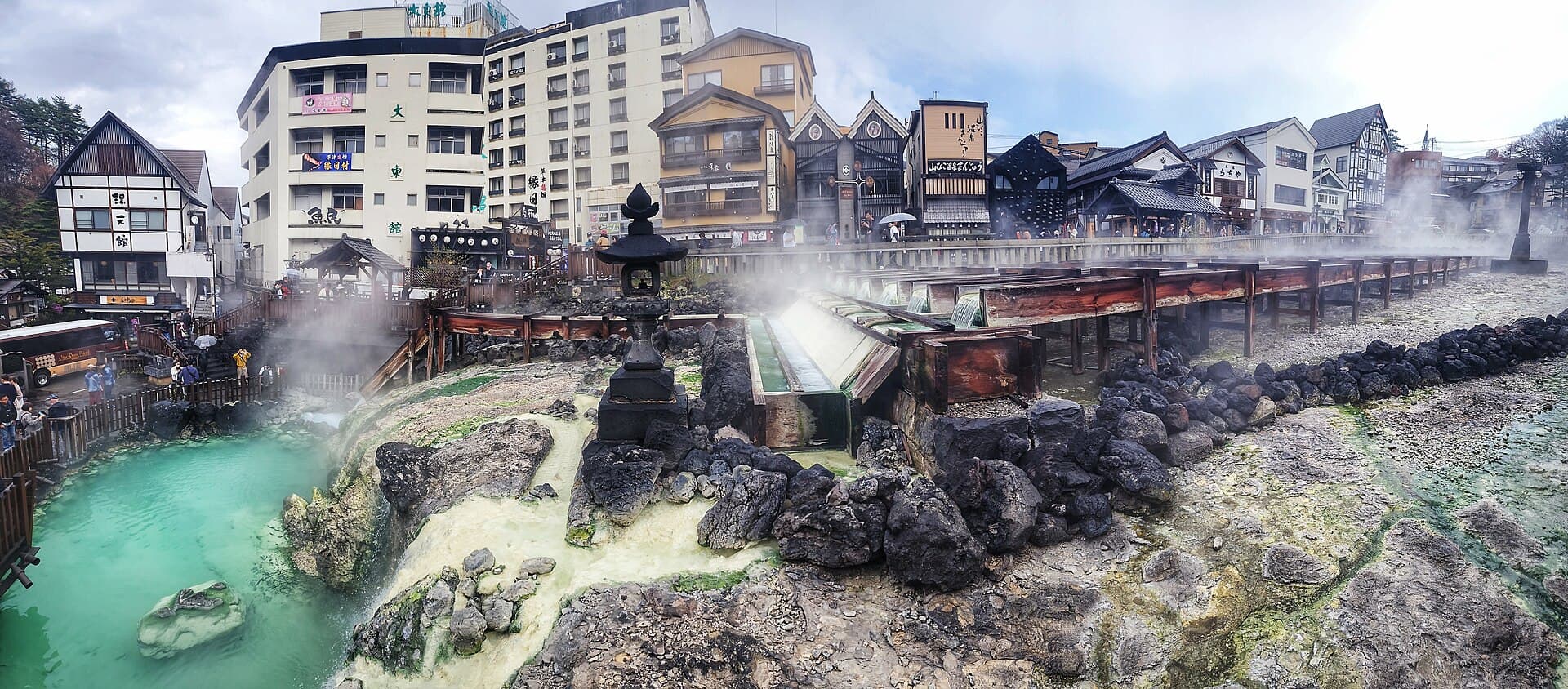
Kusatsu (草津) has topped Japan's national "favorite hot spring" polls year after year, and it's counted among the country's three great hot springs. At the heart of town, roughly 4,000 liters of spring water gush out every minute at the Yubatake (湯畑), or "hot water field" — a steaming plaza that is the romantic center of the whole town. Sitting at 1,200 meters above sea level, it's cool in summer and offers snowy open-air baths in winter.
Kusatsu's water is strongly acidic, around pH 2. There's an old saying that it cures every ailment except lovesickness — a fair measure of just how potent this spring is.
Things to do in Kusatsu
An evening walk around the Yubatake
It's striking by day, but the real spectacle is the illuminated Yubatake at night. Walking through the rising steam in a yukata and wooden geta sandals is the highlight of any Kusatsu trip — most ryokan will lend you a yukata to wear out. First time in one? Check our guide to wearing a yukata.
Yumomi (湯もみ) performances
A traditional technique for cooling 52°C spring water by stirring it with wooden paddles instead of diluting it. You can watch it performed alongside folk songs at Netsu-no-Yu.
Free public bathhouses
Free communal baths maintained by local residents, like Shirahata-no-yu, are scattered around town. They run notably hot (44°C and up), so ease in rather than rushing.
What's the water like?
It's a strongly acidic sulfur spring with powerful antibacterial properties. It's said to help with skin conditions like athlete's foot, but if you have sensitive skin, rinse off with a light shower after bathing and moisturize afterward. The water comes from six different sources (Yubatake, Banzai, Sainokawara, and others), and each ryokan draws from a different one — checking the posted spring source (温泉表) at each bath is part of the fun. For more on spring types, see our guide to onsen types and their effects.
Choosing a ryokan by area
Walking distance to the Yubatake — best for evening strolls
The area where you can move between the Yubatake and public baths in your yukata. This is the most sought-after location in Kusatsu and books up the fastest.
Toward Sainokawara — large open-air baths
Famous for a 500 m² open-air bath in Sainokawara Park to the west. A good fit for a relaxed stay that includes a walk through the park.
The outer plateau — quiet, resort-style stays
Forest ryokan and hotels set away from the noise of town. In winter, these pair well with the nearby Kusatsu Onsen ski resort.
Getting there
- 1Tokyo (Ueno) to Naganohara-Kusatsuguchi: About 2 hours 30 minutes on the Kusatsu Shima limited express, then a 25-minute bus ride.
- 2Via Karuizawa: 70 minutes on the Shinkansen plus about 80 minutes by bus. Pairing a night in Karuizawa with Kusatsu is a popular route.
- 3A direct highway bus from Shinjuku (about 4 hours) skips the transfers entirely.
How to choose
- First visit, evening strolls → open-air bath ryokan near the Yubatake
- Full immersion in the spring water → ryokan with natural spring baths
- Couples, more privacy → ryokan with in-room open-air baths or private bath ryokan
💡 Winter snow season (December–February) is peak season in Kusatsu. Book popular ryokan within walking distance of the Yubatake at least two months out.
Where can you experience this?
Book directly at Japan's best onsen towns with Ryokanear.