
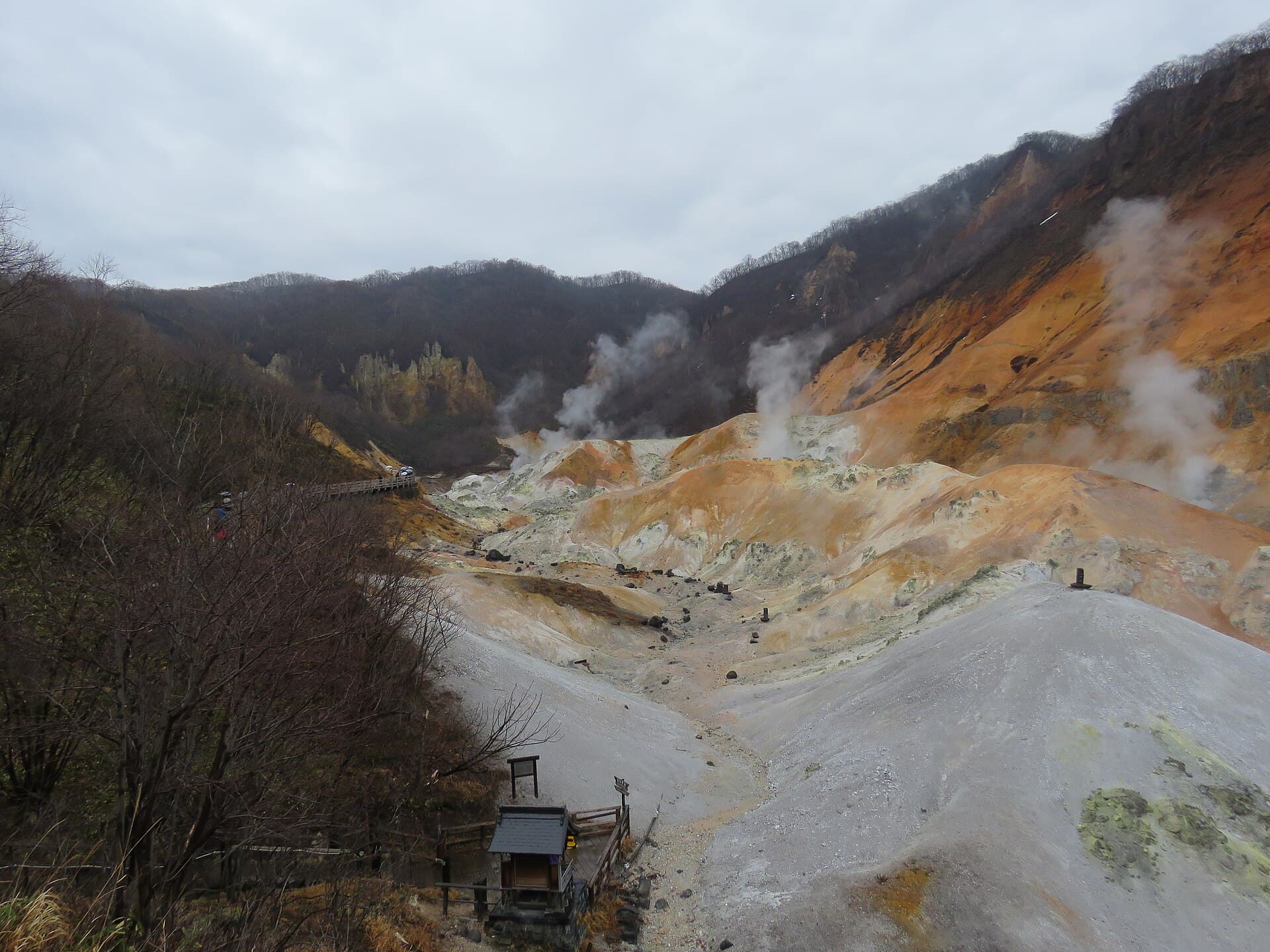
Noboribetsu (登別) is Hokkaido's premier onsen town. Just behind the hot spring district sits Jigokudani (地獄谷), or "Hell Valley," a volcanic crater that still pours out around 10,000 tons of hot spring water every day. What makes it remarkable is the variety: sulfur, salt, acidic iron, and alum springs are just a few of the nine spring types found within a single town. It's a rare enough mix that even a single well-equipped ryokan can give you a full onsen-hopping experience under one roof.
Large ryokan in Noboribetsu often divide their grand bathing halls by spring type. Working your way from the milky white sulfur bath, to the brown iron bath, to the clear salt bath is one of the town's unique pleasures.
Things to do in Noboribetsu
Walk through Jigokudani
Ten minutes on foot from the hot spring district. A network of walking paths winds through the pale, sulfur-steamed valley. In the evening, the path is lit up as the "Path of the Demon's Fire" (鬼火の路), making for an atmospheric night walk.
Oyunuma natural foot bath
Deeper inside Jigokudani, a natural stream heated by hot spring water doubles as a free foot bath. Just dip your feet into the forest stream (check for winter access restrictions).
Bear Park and Date Jidaimura
A ropeway ride up to the bear park, plus an Edo-period theme park, round out a solid family itinerary.
What's the water like?
The signature spring here is sulfur water — the faint egg smell and cloudy, milky-white color are what "real onsen" feels like to a lot of travelers. If it's too strong on your skin, alternate with a simple thermal or salt spring bath instead. For more on what each spring type does, see our guide to onsen types and their effects.
Choosing a ryokan
The main hot spring district — large ryokan built for bath-hopping
Big ryokan within walking distance of Jigokudani compete largely on how many types of baths they offer. Many also put Hokkaido seafood like crab and salmon roe on their dinner buffets, which makes them a strong pick for families.
Smaller, upscale properties — a quieter stay
Boutique ryokan with fewer rooms tend to pair in-room open-air baths with private dining. If you're visiting as a couple during snow season, this is the way to go.
Pairing it with another destination
Lake Toya with its lakeside onsen, or Jozankei near Sapporo, both pair well with Noboribetsu for a two-night Hokkaido onsen trip.
Getting there
- 1New Chitose Airport to Noboribetsu: About 1 hour 5 minutes on the JR limited express, plus a 15-minute bus from the station. This is the easiest onsen town to reach straight from the airport.
- 2Sapporo to Noboribetsu: About 1 hour 10 minutes on the JR limited express.
- 3A reservation-based direct bus from the airport or Sapporo runs straight into the hot spring district with no transfers.
How to choose
- Bath-hopping, family trips → large open-air bath ryokan in the main district
- A snowy couples' getaway → ryokan with in-room open-air baths
- Full immersion in the spring water → ryokan with natural spring baths
💡 Hokkaido onsen are at their best during snow season (December–March), when open-air baths come with a snowy backdrop — but that's also when flights and rooms are priciest. For better value, October's foliage or June's fresh greenery are just as rewarding.
Where can you experience this?
Book directly at Japan's best onsen towns with Ryokanear.